Our curriculum
Our children benefit from an exciting and engaging curriculum which has been developed to ensure that learning is irresistible for children. We ensure learning includes memorable experiences, is sequenced in a logical and progressive way, and is built upon a range of high quality texts. We share the purpose of learning and provide an audience for the children’s outcomes wherever possible.
‘An inspirational curriculum‘ is at the heart of our vision. Teachers plan for a curriculum that inspires, motivates and engages all children in memorable experiences. Connections are made between subject areas to ensure learning contexts are authentic and meaningful and provide opportunities for application of skills, investigation and purposeful play. “It’s not what you do but the way that you do it.” Careful consideration is given to the intent, implementation and impact of all learning sequences.
Our school is situated in a small market town in the largely rural county of Wiltshire. Our curriculum recognises our location in South West England and ensures knowledge and understanding of the deep history and varied geography that permeates the region, from Eddington to the city of Bath.
The curriculum is inclusive, ensuring good progress and attainment for every child. Appropriate scaffolding enables children to succeed, both in the classroom and through additional learning support. The success of children on the SEN Register is monitored across the curriculum, through SEN surgeries and regular focused learning walks. Curriculum design is intentionally ambitious for all children, including disadvantaged learners. Teachers recognise that the strength of the curriculum is only as good as the progress of our most vulnerable children.
Equality and diversity are woven through our curriculum, ensuring it represents all cultures and backgrounds and that children develop their knowledge and thinking as global citizens. Teaching opportunities are carefully planned and plotted across each topic and subject, in each year group. Children are taught about significant figures, who are carefully selected to ensure they are presented with a diverse range of people.
In Early Years (Nursery / Reception), we plan for children to have rich experiences in all the areas of learning. Teachers ensure the environment, interactions, and routines are of a consistent high quality, to support the children’s progress towards independence and to enable them to be successful in the next stage of their education.
Closely following the National Curriculum, our teachers are provided with the framework of an ambitious, coherently planned curriculum that is sequenced to ensure cumulative knowledge and skills. This includes a developing vocabulary progression to ensure children can use more words to support their learning. This in turn ensures that children develop a depth of knowledge which enables them to apply their thinking and, in the longer term, remember the content they have been taught and connect new learning with existing knowledge.
Subject leaders and teachers think about the curriculum at three levels.
The first is the intended curriculum – the knowledge and skills that we deem essential for our children to leave our schools with at the end of Year 6. This is set out meticulously by Curriculum Leads. Subject leaders then have the responsibility to ensure depth and quality of knowledge and understanding for their subject. They are the ‘experts’ in their subject, advocate, understand and measure the impact on children’s learning and support the development of teachers’ subject knowledge.
The next level is the implemented curriculum – resources that teachers use to deliver teaching sequences. Core approaches include the use of carefully selected programmes: Read Write Inc (phonics), White Rose, Teach Handwriting, Sounds and Syllables and CUSP. These are supported by the use of prior activation maps, retrieval maps, knowledge organisers, and the teaching and learning of key vocabulary. Lessons and resources are carefully created for each year group, with consideration of what has been taught before, what will follow, and any gaps.
The third level is the enacted curriculum, where our teachers bring the curriculum to life in a way that is meaningful, bespoke to the children they know so well, and responsive to both formative and summative assessment. Teachers make refined decisions about what is fundamental for their children’s progress, based on knowledge of what they currently know, understand, and can do – always mindful of the expected outcome. They plan lessons to address key concepts, typical misconceptions, and the most compelling routes to enable mastery.
Ensuring the impact of our curriculum on the children is crucial, in terms of progress and attainment as well as building their confidence and understanding of the world to enable them to participate fully in all the opportunities they may be presented with in life. In order to understand what children know, remember, and can do from the taught curriculum we undertake regular reviews and a range of monitoring and evaluation activities.
The aim of our curriculum is to develop:
-
Avid and fluent readers
-
Fluent mathematicians
- Ambitious and curious learners
- Confident writers
-
Confident problem solvers
-
Effective citizens who nurture and support others
We do this by providing children with:
- An Early Years curriculum that launches children’s curiosity and provides the foundations for future learning
- Knowledge that interconnects and is closely linked to the area we live in
- Quality first teaching, with equity for all at its heart
- A rich variety of memorable experiences, that challenge
- Access to an immersive reading spine, that will nurture a lifelong love of reading and literature
- Opportunities to write across a wide range of meaningful contexts
- Learning and challenges that create fluent mathematicians who can reason and solve problems
- Exposure to, and understanding of, the Arts, fostering a love and appreciation of the Arts in all forms
- The chance to be leaders, and become fluent and articulate speakers
- Experiences that make them inquisitive, fostering curiosity and thirst for scientific and technological discovery
- The opportunity to develop an understanding of how to care for their bodies and minds
- An environment that is inclusive, and celebrates diversity, ensuring representation
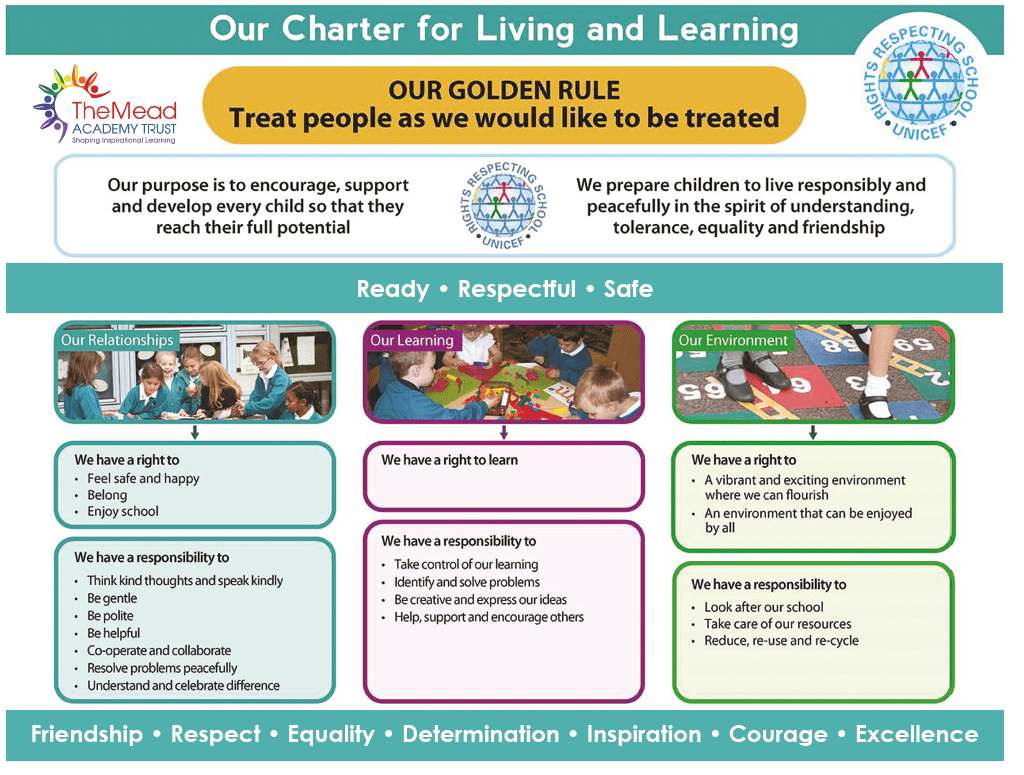
- A Charter for Living and Learning, that advocates the rights of the child and enables global citizenship through British Values
To support high quality teaching of all subject disciplines, we use the following approaches:
Maths: We draw upon White Rose Maths planning and resources to create high quality sequences of learning and lessons that focus on developing fluency and mastery. Problem solving is woven throughout the curriculum as teachers plan for all children to have the opportunity to think hard.
Art: We have a bespoke art curriculum written by our art specialist teachers. Art links, where applicable, to the wider curriculum and focuses on skills and processes of art and the importance of sketch books to support this.
Design and Technology: We use Projects on a Page from the D&T Association to support planning units of work.
Computing: We use schemes of learning from Teach Computing to teach and explore the computing curriculum.
PSHE: We use SCARF to deliver our PSHE and RSE curriculum alongside assemblies.
PE: We use a bespoke PE curriculum supported by Get Set 4 PE; the PE specialist teaches one PE lesson a week with the other being taught by class teachers.
RE: We use Discovery RE to teach RE. Children explore two religions in depth, one being Christianity, each year. Parents should talk to the head teacher if they would like to remove their child from RE lessons.
MFL: We use Language Angels in Key Stage 2 to support our teaching of French.
Our wider curriculum is carefully curated to support the development of the whole child, including:
-
Visits and visitors to extend the children’s opportunities and develop their understanding of others religions (Mosque, Hindu Temple, Church, Buddhist Visitor)
-
Enrichment opportunities that may include author visits, performing in a local theatre, music and dance events, and sports’ fixtures
-
An outdoor and adventurous curriculum, including residentials and water sports day
-
A rich play curriculum at playtimes and lunchtimes
- A forest school provision
-
School parliament and leadership opportunities, such as Sports’ Leaders, Playground Buddies, and Trowbridge Youth Parliament Representatives
-
Celebrating achievements, through Star of the Week, Hot Chocolate Awards and celebration assemblies
-
A range of extra curricular clubs, including whole school performance
Alongside our mainstream curriculum, we ensure:
- Children have access to an adaptive curriculum and personalised learning plans where they have additional needs
-
Interventions are targeted, timely, and evidence-based
Our assessment is through key approaches, including:
-
Use of prior activation maps and retreival maps
- Individual and class conferencing / feedback
- Pre-teaching
- Responsive teaching and the routine checking of children’s understanding and remembering
- Regular checking of books by teachers and leaders and discussions with children about their learning
-
Planned summative (standardised) assessments
We measure the effectiveness of our curriculum, these checks are done through:
-
Pupil Book Study
-
Collaborative Reviews
-
Education Reviews (ERs)
-
Pupil Progress Reviews
-
Trust Moderation
 Castle Mead School, Mascroft Road, Trowbridge, WILTSHIRE, BA14 6GD, Tel: 01225 768641 | Email: office@castlemead.equamead.org | Email: nursery@castlemead.equamead.org |